

Product
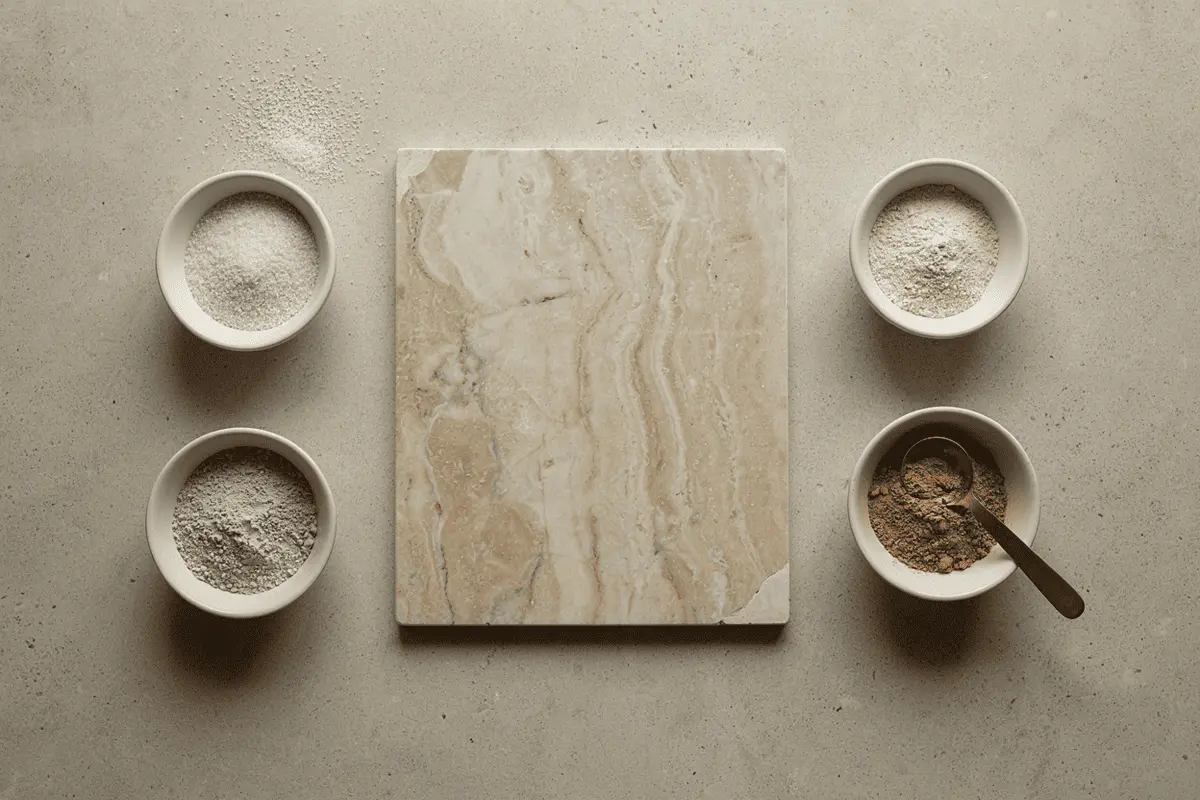
You run your hand across a smooth, cool countertop and it feels just like stone, but it looks a bit too perfect to have come straight out of a quarry. So what is sintered stone made of, and why does it behave so differently from marble, granite or quartz? If you’re comparing surfaces for your kitchen or bathroom, knowing what’s inside the slab makes it much easier to understand why it performs the way it does.
The Main Ingredients
Sintered stone is made almost entirely from natural minerals. There are four main building blocks:
- Silica and quartz sand: This forms the hard, durable backbone of the slab and gives it strength and scratch resistance.
- Feldspar: A natural mineral that melts at high temperature and acts like glue, helping all the particles fuse together without any added resin.
- Clay: Helps the powder hold its shape when pressed and adds to the slab’s density and stability.
- Mineral pigments: Natural oxides that give each slab its colour, from soft whites and warm travertine tones to deep charcoal and bold veining.
Some manufacturers also add recycled mineral material to the mix, though this varies by brand. What matters is that there’s no resin binder holding everything together, which sets sintered stone apart from engineered quartz. Each ingredient does a specific job, and the balance between them is what gives a good slab its strength, its colour and its smooth finish.
How the Ingredients Become a Slab
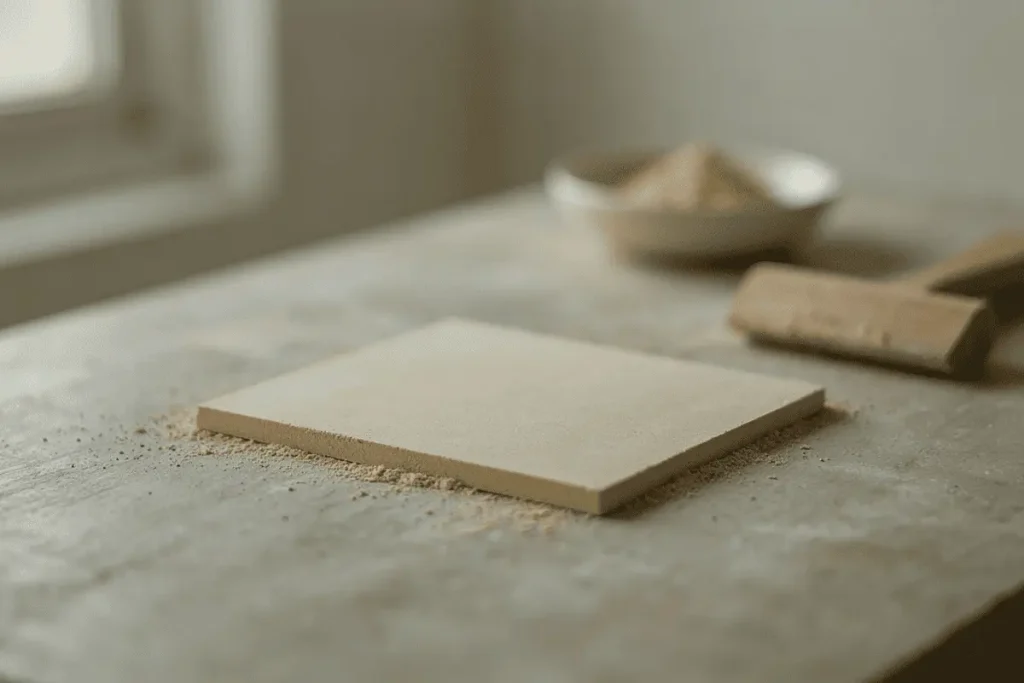
Having the right minerals is only half the story. The way they’re processed is what turns loose powder into a surface strong enough for a busy kitchen. The process usually goes like this:
- Grinding and blending: The raw minerals are ground into very fine powder and mixed in carefully measured amounts, so that every batch is consistent.
- Pressing: The powder is compacted under enormous pressure, which squeezes out air and packs the particles tightly together into a flat slab.
- Decorating: Modern printing methods apply the colours and patterns, whether that’s marble veining, travertine texture or a plain concrete look.
- Firing: The slab goes into a kiln and is fired at extremely high temperatures, well above 1,000°C. This is the sintering step, where the particles fuse into one dense, solid piece.
- Cutting and finishing: Once cooled, the slab is trimmed and given its final finish, such as polished, matte or textured.
Think of it as baking, just on an industrial scale. The pressure packs everything tightly, and the heat locks it all in place for good. Because every step is carefully controlled, a well-made slab ends up with the same thickness, colour and strength from one edge to the other.
Why the Ingredients Matter
Once you know what goes into a slab, the benefits make a lot more sense. Because there’s no resin, there’s nothing in the surface that softens or discolours under heat or long exposure to sunlight, which is why sintered stone is often used on balconies and for outdoor cladding. The firing process also leaves a dense, non-porous surface, so oil, sauces and spills have very little chance to soak in. That’s good news for busy Singapore kitchens, and it also means the surface doesn’t need sealing the way many natural stones do.
Compare that with engineered quartz, which is mostly crushed quartz bound together with resin and pigments. It’s a great material, but the resin is the part that’s more sensitive to high heat and strong UV. Granite and marble, on the other hand, come straight from the earth, so each slab is unique but can have natural pores, fissures and weak spots. Sintered stone sits somewhere in between: natural minerals like stone, but made in a controlled way, so the result is more consistent. For a family that cooks daily or loves entertaining outdoors, that predictability is a big part of the appeal.
Is It Natural or Man-Made?
The honest answer is both. The raw materials are natural, but the slab itself is manufactured, which is why it’s called an engineered surface. There’s one more thing worth knowing. Like granite and quartz, the minerals contain silica, and cutting or grinding the slab can create fine dust. That’s a workshop concern and not something you’ll face at home. A responsible fabricator uses wet cutting and proper protection, and once installed, the finished surface is completely stable and safe for everyday use, including food preparation.
What to Look for When Buying
Since quality depends so much on the ingredients and process, it’s worth being a little picky:
- Choose an established brand: Reputable manufacturers control their raw materials and firing closely, so colour and thickness stay consistent from slab to slab.
- Ask about the composition: A good supplier can tell you what the slab is made of and whether any resin is used.
- Check the fabrication: Dense slabs need experienced installers with the right tools, so ask who will cut and install it.
- See a real sample: Always look at and touch the actual slab, since printed colours can look different under showroom lights and at home.
The Simple Recipe Behind a Tough Surface
In short, it’s made of natural minerals like silica, feldspar and clay, plus mineral pigments, pressed together and fired at very high heat until they fuse into one dense slab. No resin, no sealing, and a surface built to handle heat, stains and sunlight. That simple recipe is the reason it has become such a popular choice for modern kitchens, bathrooms and outdoor spaces.
If you’d like to see and feel the difference for yourself, drop by Polybuilding and our team will gladly show you our LAMINAM sintered slabs in person and help you find the right fit for your home.
Get in Touch
We value action, ownership, accountability, honesty, and the ability to make tough decisions.
8 Tuas Avenue 11, Jurong,
Singapore 639074
Singapore 639074
Mon-Thurs:
9.00am – 6.30pm
Fri:
9.00am – 5.30pm
Sat:
10.00pm – 4.00pm
Any other timings by appointment only.
Sun & Public Holidays Closed
Get in Touch
We value action, ownership, accountability, honesty, and the ability to make tough decisions.
We are Singapore’s leading natural stone and tile suppliers, stocking an extensive range of the finest quality marble, granite, limestone, travertine, onyx, quartz, sandstone, homogeneous tiles, and agglomerate compressed stones.
Sodalite Blue Kitchen Island
Statement kitchen countertop featuring a double waterfall edge. Shown in Sodalite Blue marble, in a polished finish.
Capitol Building
A high traffic commercial shopping space featuring the following materials: Travertine Silver Epoxy Filled & Honed, Carrara White Polished Marble wall


