

Product

Walk into any stone showroom today and you’ll hear the same question from homeowners: should I go for quartz or sintered stone? Both are popular for kitchen countertops, vanities and wall features, both look great, and both promise low maintenance. So what actually separates them? If you’re stuck on quartz vs sintered stone, this guide breaks down the real differences in plain language, so you can pick the one that fits the way you live.
How They’re Made
The easiest way to understand the difference is to look at what’s inside. Engineered quartz is made mostly from crushed natural quartz, which is mixed with resin and pigments and then pressed into slabs. The resin acts as the binder and gives quartz its smooth, flexible, easy-to-work character. Quartz has been a favourite in Singapore kitchens for years, so it’s a familiar and well-tested option.
Sintered stone takes a different route. It’s made from natural minerals such as silica, feldspar and clay, which are pressed under very high pressure and fired at extreme heat until they fuse into one dense slab. There’s no resin at all. That single difference explains most of what follows, from how each surface handles heat to how it behaves outdoors. At Polybuilding, for example, you’ll find engineered quartz from brands like Cambria, Luxora and Quarella, and large-format sintered slabs from LAMINAM, so it’s easy to compare both under one roof.
Quartz vs Sintered Stone in Everyday Life
Here’s how the two compare on the things that matter most once the renovation is over:
- Heat: Sintered stone handles high heat very well because it’s fired at high temperatures during manufacturing. Quartz can cope with normal cooking, but the resin makes it more sensitive to a very hot pot placed straight on the surface, so a trivet is a must.
- Stains: Both are non-porous and resist staining from oil, sauces, coffee and wine, and neither needs sealing. Sintered stone has a slight edge with harsh stains like turmeric and dark spices, though a quick wipe works on both.
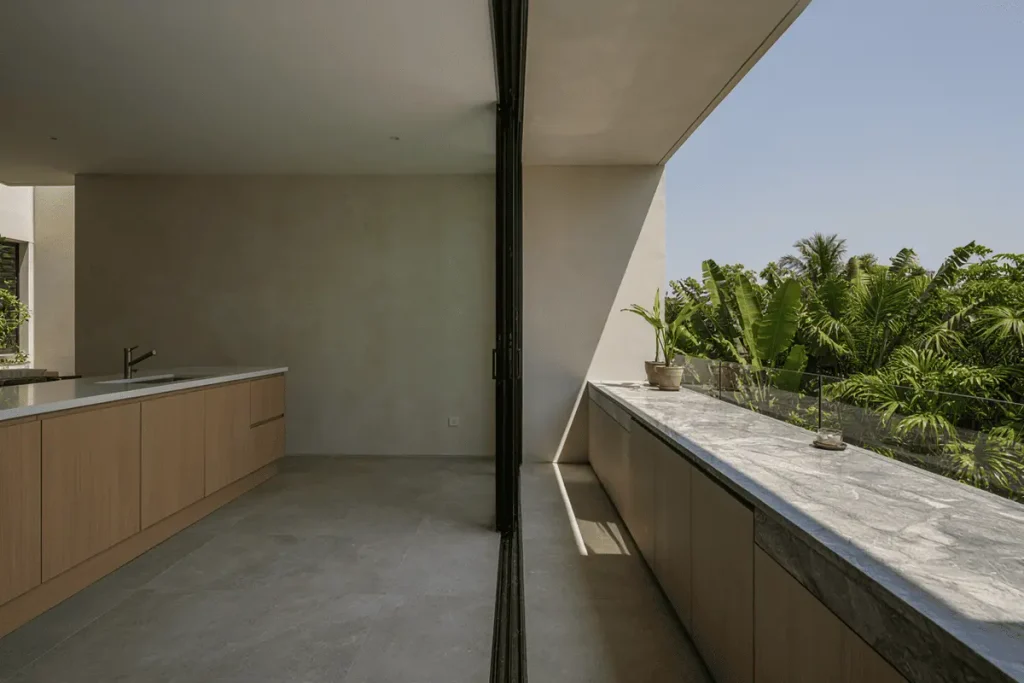
- Sunlight and outdoor use: Sintered stone is UV-resistant and keeps its colour on balconies and in outdoor kitchens. Quartz is best kept indoors, since long exposure to strong sun can cause the resin to fade or yellow over time.
- Scratches: Both are hard and durable, but sintered stone tends to be more scratch-resistant. You should still use a chopping board with either one.
- Appearance: Quartz offers a huge range of colours and a consistent, uniform look. Sintered stone is excellent at copying marble, travertine and concrete, often with more natural-looking veining and large slabs that run with fewer joints. Both come in polished and matte finishes, so the look you want is rarely out of reach.
- Fabrication and edges: Quartz is generally easier to cut and shape, so decorative edge profiles are more widely available. Sintered stone is denser and needs experienced fabricators and the right tools, and some edge styles are harder to achieve.
- Cost: Prices overlap a lot and depend on brand, thickness, design and installation. Good-quality quartz and sintered stone often sit in a similar range, so it’s best to compare quotes based on your own layout.
Which One Should You Choose?
There’s no single winner, because the better choice depends on your home and your habits. Quartz is a smart pick if you want a wide range of colours, more edge options and a surface that’s friendly to fabricate. It’s a proven all-rounder that works very well in most indoor kitchens and bathrooms, and it’s often the more comfortable choice for a tighter budget or a complex layout. Day to day, it’s also very low fuss, with no sealing and only a soft cloth and mild soap needed to keep it clean.
Sintered stone makes more sense if you cook with high heat every day, have a kitchen that gets strong sunlight, or want to extend the same material to a balcony, outdoor kitchen or feature wall. It’s also a good fit if you love the idea of a large, seamless slab that runs from countertop to backsplash with very few joints. In bathrooms, both work well on vanities, but sintered stone’s large slabs can also clad walls and shower areas for a clean, low-grout look in humid spaces.
If you can’t decide, think about the one thing you’d hate most to deal with. For some people that’s a heat mark, for others it’s a difficult installation or limited design options. Answering that honestly often settles the debate. Neither is a bad choice, so the real goal is a good match, not a perfect material.
Things to Check Before You Commit
Whichever material you lean towards, a few simple steps will help you avoid surprises:
- Look at real samples: Colours and finishes can look very different under showroom lights and at home, so view and touch the actual slabs.
- Ask about the brand: Established brands offer more consistent colour, thickness and quality from slab to slab.
- Confirm the installer’s experience: Sintered stone in particular needs a fabricator who has worked with large, dense slabs before.
- Think long term: Consider how your needs may change, such as a future outdoor kitchen or a growing family, and pick the surface that will still suit you in ten years.
- Share your measurements: The cost and number of slabs depend on your layout, so a proper quote is the only way to compare accurately. It also helps to tell your supplier how you cook and how much sun your kitchen gets, so they can point you to the right surface from the start.
Making the Choice Easier
Both are strong, long-lasting surfaces, and many homeowners are happy with either. The right one is simply the one that matches your cooking style, your design taste and your budget.
Still on the fence? Come by Polybuilding and see our quartz and LAMINAM sintered slabs side by side. Seeing and touching them together is often the quickest way to know which one feels right for your home. Our team can explain the trade-offs honestly, whichever material turns out to be the better fit.
Get in Touch
We value action, ownership, accountability, honesty, and the ability to make tough decisions.
8 Tuas Avenue 11, Jurong,
Singapore 639074
Singapore 639074
Mon-Thurs:
9.00am – 6.30pm
Fri:
9.00am – 5.30pm
Sat:
10.00pm – 4.00pm
Any other timings by appointment only.
Sun & Public Holidays Closed
Get in Touch
We value action, ownership, accountability, honesty, and the ability to make tough decisions.
We are Singapore’s leading natural stone and tile suppliers, stocking an extensive range of the finest quality marble, granite, limestone, travertine, onyx, quartz, sandstone, homogeneous tiles, and agglomerate compressed stones.
Sodalite Blue Kitchen Island
Statement kitchen countertop featuring a double waterfall edge. Shown in Sodalite Blue marble, in a polished finish.
Capitol Building
A high traffic commercial shopping space featuring the following materials: Travertine Silver Epoxy Filled & Honed, Carrara White Polished Marble wall


